
From the Journal · November 9, 2026
MacKenzie Price Is Building Geniuses — and Chicago Just Got a Front-Row Seat
Alpha School opened its Loop campus on September 8. Two focused hours of academics, then an afternoon of public speaking, entrepreneurship and real projects. Here is why we believe this work will change lives, with the numbers behind it.
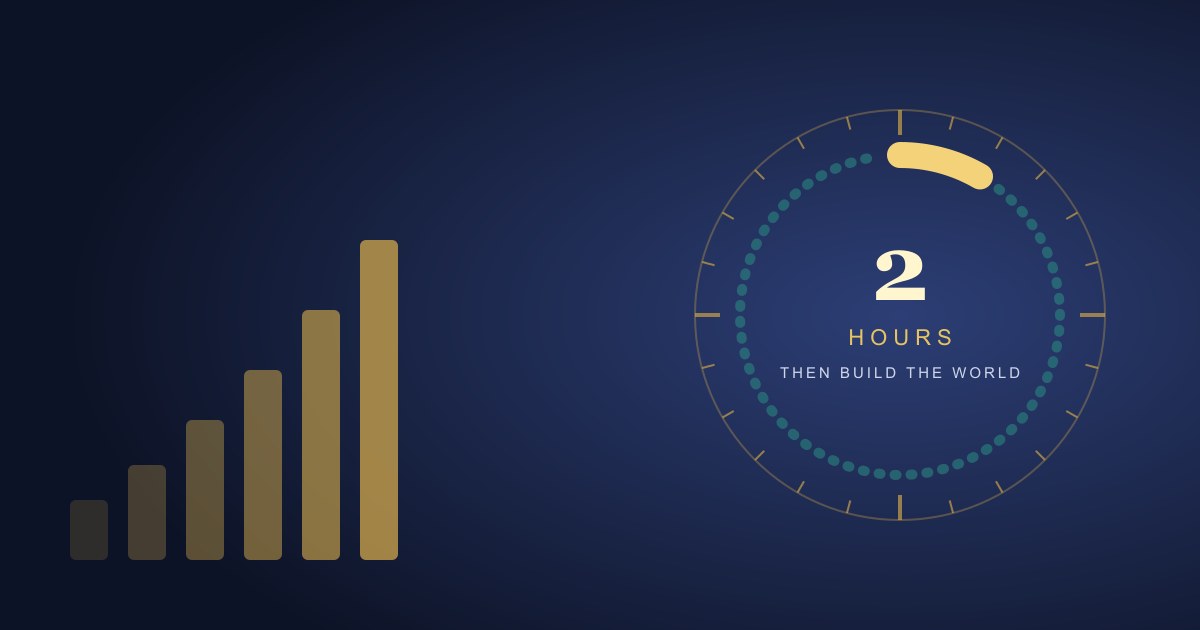
We have always believed something simple: teach young people big skills early and you change the whole arc of their lives. Make the work feel like play, and they will do it before they ever realize it is work. Children are naturally brilliant. Too often, what holds them back is not their ability. It is a system that waits too long, moves too slowly, and keeps cutting the early-learning programs that matter most.
So when a clip of CBS News going inside an AI-driven school came across our feed, followed by a look at the new Alpha School campus in Chicago, we stopped scrolling. The person behind it is MacKenzie Price, and her profile says it in one line: “School wasn’t working for my kid so I co-founded my own. Let’s revolutionize education together!”
A mother who refused to accept “bored”
Price is a Stanford-educated psychologist. Her daughters went from curious and excited to “totally bored” at a top-rated traditional school. Most parents complain. She built something. In 2014 she co-founded Alpha School in Austin, Texas, with Brian Holtz, and turned it into what she calls 2 Hour Learning: core academics compressed into a focused morning block of personalized, mastery-based software, so a child moves on only once a topic is truly learned. The rest of the day goes to the things school rarely makes time for.
She has carried the idea far beyond one building. Her Future of Education newsletter (find all of it at her Future of Education links) and appearances on shows such as Ed on the Edge and Modern Wisdom have put the question in front of hundreds of thousands of parents: why should a child spend six hours a day on what they could master in two?
What opened at 350 East South Water Street
Alpha Chicago opened on Tuesday, September 8, 2026, in the Loop’s Lakeshore East neighborhood, inside the former GEMS World Academy building. It serves PreK through 8th grade and, according to Block Club Chicago, planned to start with about 100 students. Here is what a day looks like:
- Morning: a group kickoff, then about two hours of core academics on adaptive software. Alpha’s own platform works alongside programs including Khan Academy, Membean, Mentava and MobyMax. Alpha explains the approach on its The Program page. No textbooks. No homework.
- Afternoon: hands-on workshops in public speaking, entrepreneurship, teamwork and leadership, plus financial and tech literacy, all part of Alpha’s Life Skills Workshops. Past projects at Alpha campuses include running a food truck, giving TEDx Youth talks, building apps and managing an Airbnb.
- The adults: instead of lecturers, “guides” who coach, motivate and support, with starting pay that reaches six figures. Subject experts join by video when a child is stuck.
Look at that afternoon list again. Eight-year-olds pitching a business. Ten-year-olds managing a property listing. That is exactly what we mean by making them work before they realize it is work.
Chicago is the right city for this
There is a quiet poetry in this campus landing in Chicago. In 1984, University of Chicago researcher Benjamin Bloom published “The 2 Sigma Problem”. He found that an average student who was tutored one-on-one, and allowed to master each step before moving on, outperformed about 98% of students taught in a conventional classroom. His challenge to the world was to find a way to give every child that experience without hiring a tutor for every child.
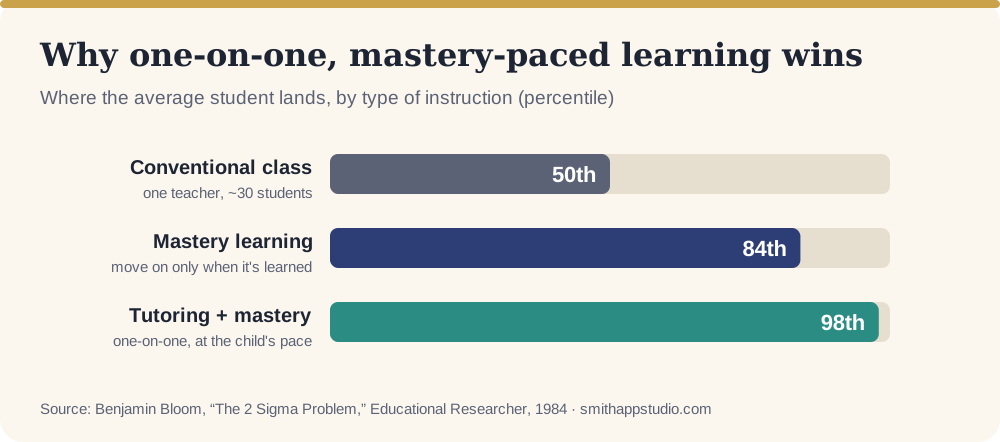
Forty years later, that is the exact problem 2 Hour Learning is built to solve. Independent research is pointing the same way. A 2025 randomized trial in a Harvard physics course found students learned more than twice as much with an AI tutor as in a well-run active-learning class, and finished in a median of 49 minutes instead of 60. The same learning in less time is the whole idea behind a two-hour school day.
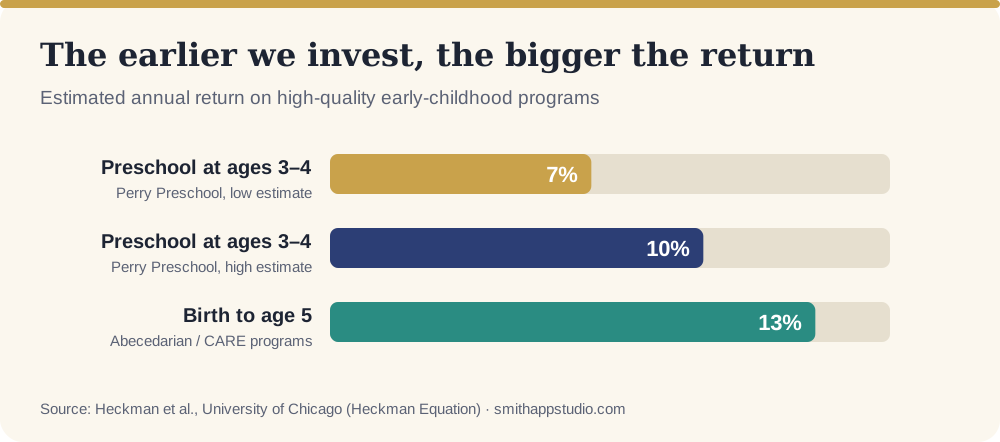
Chicago is also home to Nobel laureate economist James Heckman, whose research shows how much early learning pays off. High-quality programs that start from birth to age five return about 13% a year through better health, schooling, earnings and behavior. That beats preschool that starts at three or four, which returns about 7–10%.
The early years are where we keep failing
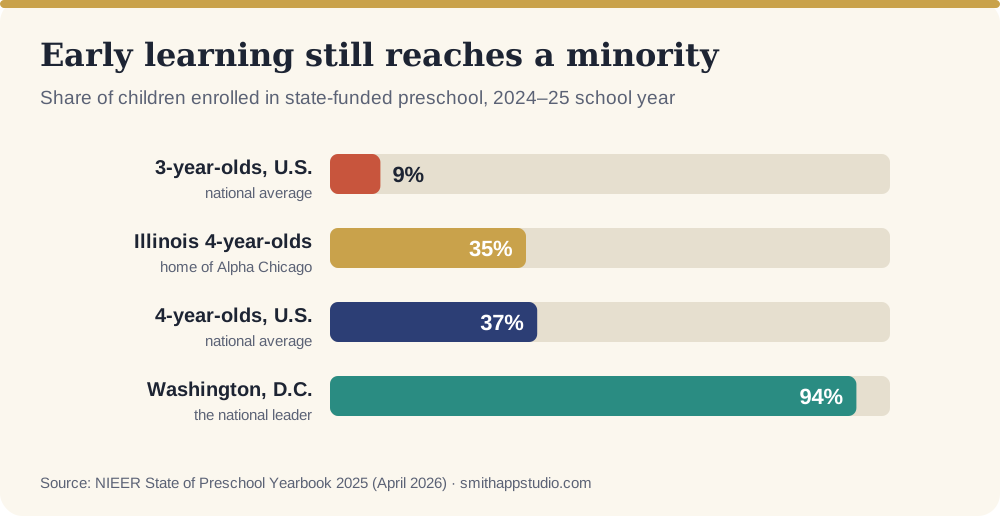
The evidence says start early, yet the country still leaves most young children out. According to NIEER’s State of Preschool Yearbook 2025, state-funded preschool reached only 37% of 4-year-olds and 9% of 3-year-olds nationally in 2024–25. Illinois reached 35%. Washington, D.C. reached 94%, which proves the gap is a choice and not a law of nature.
The results show up later. The 2024 Nation’s Report Card found 40% of fourth graders reading below the Basic level, the largest share since 2002. A third of eighth graders also read below Basic, the worst in the test’s history, and only 27% of eighth graders are proficient in math.
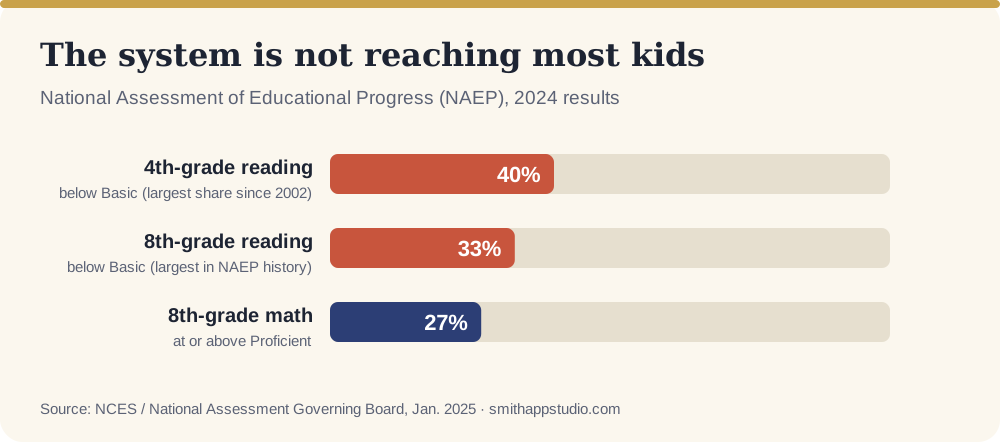
Those children are not less brilliant than Alpha’s students. They are simply being given less time, less personal attention and fewer reasons to love learning.
Children who love school
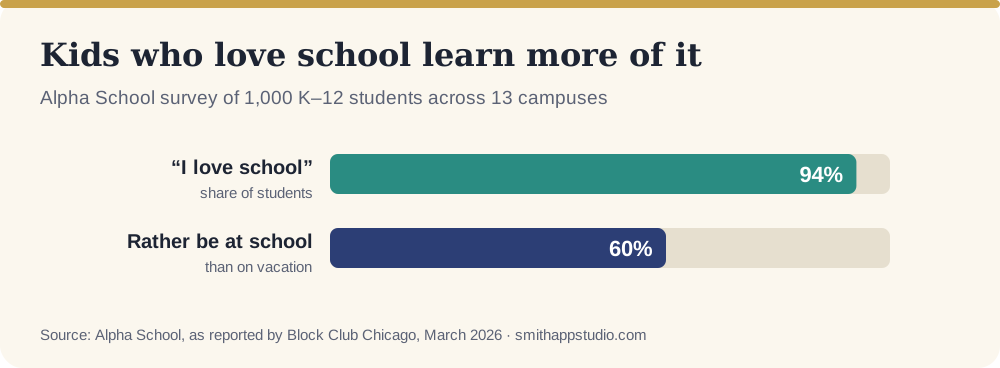
That last point may be Price’s most important result. In a survey of 1,000 Alpha students across 13 campuses, 94% said they love school, and 60% said they would rather be at school than on vacation. Enrollment grew from about 200 students to more than 1,000 in two years, and Alpha’s locations page now lists campuses in 17 states plus Puerto Rico.
On academics, Alpha reports that its classes score in the top 1–2% nationally on NWEA MAP tests and grow about twice as fast as their peers. Serious reporting is now testing those numbers. In October, a New York Times analysis found that 42% of students hit the full “2x” growth target in both math and reading. A researcher at Northwestern University called the wider research “mixed”. We welcome that scrutiny. It is how a bold idea gets sharper. And the debate only exists because someone was brave enough to build the school instead of writing another white paper about it.
Alpha’s programs, in one place
For parents who want to see the model for themselves, here is where to start:
- Alpha Chicago: the PreK–8 campus at 350 East South Water Street, with virtual information sessions on November 11 and 18, a book-a-call link and the Chicago application.
- The Program: how Love School, Learn 2x in 2hrs and Learn Life Skills fit together.
- Life Skills Workshops: the afternoon program, from public speaking to entrepreneurship.
- 2 Hour Learning: the learning model behind every Alpha campus.
- Alpha High School for grades 9–12, and Alpha Anywhere for families who are not near a campus.
- Admission, the FAQ, the video library and Bring Alpha to My City.
Chicago coverage worth reading: the Chicago Tribune, Block Club Chicago and ABC7 Chicago.
Why this matters beyond one school
Tuition at Alpha Chicago is $55,000 a year, so today this is a private school. The ideas inside it, however, belong to everyone: mastery before moving on, personal pacing, immediate feedback, adults who coach instead of lecture, and afternoons spent building real things. Those ideas can reach every neighborhood, every library and every kitchen table. That is the future MacKenzie Price is pushing toward, and it is why we think her work will change the world.
We are writing about it across our family of apps. On ExamPilot, we look at what families can borrow from the model at home. On Nexaria Digital, we look at the young builders those afternoon workshops are creating.
MacKenzie, if this reaches you: thank you. Keep building geniuses.
This piece was written by Smith App Studio. More plain-English writing on learning and technology is in the Smith App Studio Journal.