
From the Journal · October 5, 2026
NFC Child Safety Fobs: How One Tap Can Speak for a Child Who Can’t
A tap-to-read tag will not replace supervision or GPS. But for the moments when a child cannot explain who they are or what they need, it closes a dangerous gap — in seconds, with nothing to download.
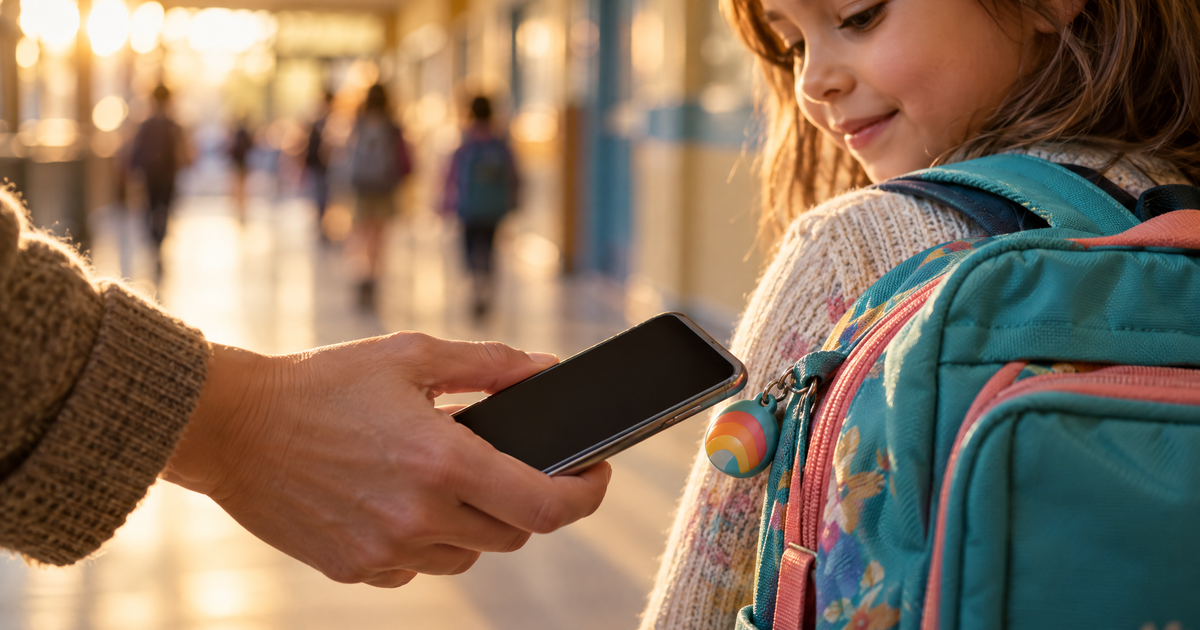
An NFC child safety fob is a small tag — clipped to a backpack, zipper pull or shoelace — that any adult can tap with a phone or scan as a QR code to open a parent-controlled profile: emergency contacts, how the child communicates, and what helps them feel calm. There is no app to install, no battery to charge and no location being broadcast. It answers one urgent question fast: who is this child, and what do they need right now?
Why that question is so hard to answer
About one in six children aged 3 to 17 in the United States has one or more developmental disabilities. Autism alone is now identified in 1 in 31 eight-year-olds, according to the CDC’s most recent surveillance data — up from 1 in 36 two years earlier.
The safety math follows from there. A 2012 Pediatrics study found that 49% of children with autism are prone to wandering away from a safe place such as home or school. More than a third of the children who wander are never or rarely able to communicate their own name, address or phone number. Accidental drowning accounts for roughly 90% of lethal outcomes after a wandering incident. And half of the families surveyed said no professional had ever offered them guidance on the subject at all.
These are not abstract figures. They describe one specific, repeating scene: a child is found, a stranger wants to help, and the information that would end the emergency in thirty seconds is locked inside a child who cannot hand it over.
What a tap actually does
Near-field communication is the same technology behind tap-to-pay. Virtually every modern phone reads an NFC tag by being held near it — no app, no pairing, no account. A QR code printed on the same fob covers anyone who would rather scan.
That is the point: the helper needs nothing. A teacher, a lifeguard, a police officer or a stranger in a parking lot gets what they need using hardware already in their pocket.
A product doing it well
TapAble builds exactly this. Its fobs are $19.99 with free shipping in eight designs — butterfly, dinosaur, rocket, unicorn, soccer ball, football, puzzle piece and a plain logo — paired with a $7.99-a-month profile that is free for the first 30 days. Parents choose exactly what a helper sees: contacts, communication guidance, calming strategies, or whatever else matters.
The design decision we admire most is the least technical one. The child picks the fob. A tag a kid actually wants on their backpack is a tag that stays on the backpack.
TapAble is also unusually honest about its limits, stating on its own site that it does not replace adult supervision, emergency services, professional medical identification or a GPS tracker. In a category that routinely oversells, that restraint is a credibility signal — and it is the right way to hold the tool.
Build the layers
A tap tag is one layer. Pair it with the rest:
- A written safety plan agreed with the school, folded into the IEP where there is one.
- The National Autism Association’s free Big Red Safety Box wandering-prevention toolkit.
- Swim lessons. Given the drowning figures, water competence is a safety intervention, not a hobby.
- Your local first-responder registry, or a program such as Project Lifesaver, for children at genuine elopement risk.
- A GPS device where live location is warranted — which a tap tag deliberately does not provide.
- Guidance and community through the Autism Society of America, since half of families report receiving none.
Why we are writing about it
Smith App Studio has no commercial relationship with TapAble — we came across it the way most people will, through a post in a feed. We build software for caregiving families: FamilyCare for coordinating care, CoParent for families living across two households. So we spend our days judging whether a tool lightens a parent’s load or quietly adds to it.
A fob on a zipper pull lightens it. It costs less than a car seat, never needs charging, and works on the worst day of your year without anyone having to remember how it works. That is a high bar, and not many products clear it.
For more plain-English breakdowns of the tools families actually use, the rest of the Smith App Studio Journal is here — and our services page covers what we build for the organizations doing this work.