
The Journal · Technology · October 28, 2026
3D Printing at the Speed of Light: What Idea-to-Prototype in Seconds Means for Builders
Researchers at Tsinghua University have printed objects with light in under a second. It is lab research, not a gadget, but it shows where making things is heading, and why your 3D models matter more than ever.
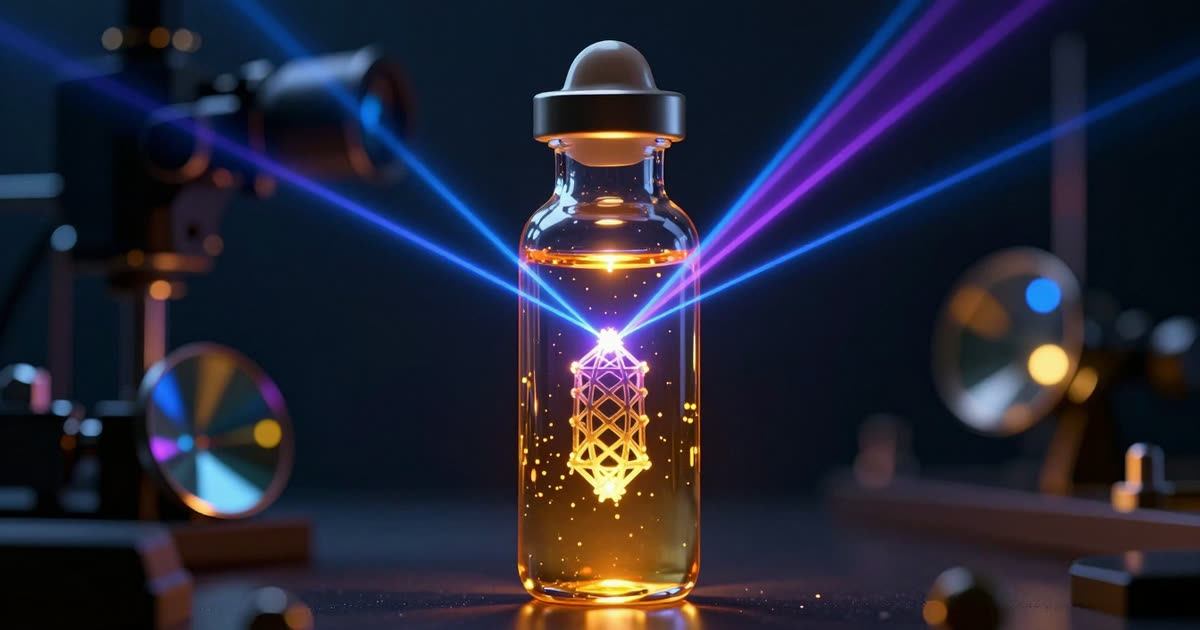
Short answer: researchers at Tsinghua University have printed small 3D objects in 0.6 seconds by shaping light inside a still vial of liquid resin, instead of building them layer by layer. It is lab research on millimetre-scale parts, not a product you can buy. But paired with AI that turns a sentence or a photo into a 3D model, it points to a near future where the gap between an idea and something you can hold almost disappears.
We first spotted the story in a widely shared Facebook reel that called it a printer that makes objects “with light” in under a second. The reel gets the headline right. A couple of details deserve a gentler, more accurate telling, so here is what was actually published, and why we think it matters for anyone who builds products, apps or virtual worlds.
What did Tsinghua University actually build?
The team, led by Dai Qionghai, Wu Jiamin and Fang Lu, published its method in Nature under the title “Sub-second volumetric 3D printing by synthesis of holographic light fields” (Tsinghua’s announcement). They call it DISH, short for digital incoherent synthesis of holographic light fields.
Most printers people know, whether they melt plastic filament or cure resin, build an object one thin slice at a time. DISH cures the whole object at once. A high-speed periscope swings the projection angle around a resin vial that never moves, while a digital micromirror device flashes carefully computed patterns of 405-nanometre laser light. Where enough light overlaps, the liquid hardens. Everywhere else it stays liquid.
How fast and how precise is it?
The exposure takes 0.6 seconds for millimetre-scale parts. The smallest features come out as fine as 12 micrometres, several times thinner than a human hair, with a steadier 19 micrometres across a 1-centimetre range. Peak throughput reached 333 cubic millimetres per second. The team printed in ordinary acrylate resins and in soft hydrogels, which is why medical and tissue-engineering researchers are paying close attention.
The honest caveat: this is still a laboratory system. It needs heavy computing before each print and specialised optics, and the parts are small. Nobody should expect one on a desk soon.
Why does idea-to-prototype speed matter for businesses?
Because the slow part of making things has never been the idea. It has been the loop: draw it, model it, print it, wait, hold it, fix it, repeat. Each lap can take days. Now look at both ends of that loop at once. AI tools can already turn a sentence or a photo into a usable 3D model. Research like DISH shows the physical end shrinking from hours toward seconds. When both ends get fast, the number of ideas a small team can test in a week goes up dramatically.
For product makers, that means more prototypes before committing to tooling or inventory. For shops and brands, it means one digital model can become a product photo, an interactive 3D view and, eventually, a physical sample. For VR and 3D world builders like us, it means the boundary between a virtual object and a real one keeps thinning. And for app builders, it means customers will expect software that moves as quickly as their ideas do.
What does this mean for the way we build at Smith App Studio?
The same 3D model is quietly becoming the most valuable file a business owns. We already build custom 3D product and character models that work everywhere: spinning on a product page, placed in a room with AR, standing on a shelf in a walkable VR store, or sent to a printer. Our piece on virtual storefronts with real products shows how one model can carry a whole shop.
If you would rather start with a space than a product, our ready-made digital spaces open from a single link on a phone, computer or headset. The lesson from Tsinghua is not that everyone needs a light-speed printer. It is that the businesses with good digital models of their products will be ready for every new way of making them real.
Curious what a 3D version of your product, venue or idea would look like? Tell us about it.
Where can I read more in this series?
- From virtual model to real object in a blink on Nexaria Digital, a marketplace for owning, listing and renting digital assets and 3D spaces
- AI and jobs: what Barclays and Microsoft tell us about 2026 here in the Journal
Frequently asked questions
What is DISH 3D printing?
DISH (digital incoherent synthesis of holographic light fields) is a volumetric printing method from Tsinghua University, published in Nature. It projects computed light patterns from many angles into a still vial of resin, curing a whole object at once instead of layer by layer.
Can I buy a printer that prints in under a second?
Not yet. DISH is laboratory research that prints millimetre-scale parts and needs specialised optics and heavy computing. Consumer printers still build objects layer by layer.
How can AI help turn an idea into a 3D model?
AI tools can now generate a 3D model from a written description or a photo. A designer then cleans it up so it works on a website, in AR, in a VR space or on a printer.
Can Smith App Studio make a 3D model of my product?
Yes. The studio builds custom 3D product and character models that can be shown on a product page, placed in a room with AR, set inside a VR store or sent to a printer. Use the contact page to describe what you have in mind.