
From the Journal · October 12, 2026
Your Products, Standing in a Room: What Real 3D Does That a Photograph Cannot
A photograph shows your customer the one angle you chose. A real 3D model lets them choose every angle themselves — and in a headset, reach out and pick the thing up.
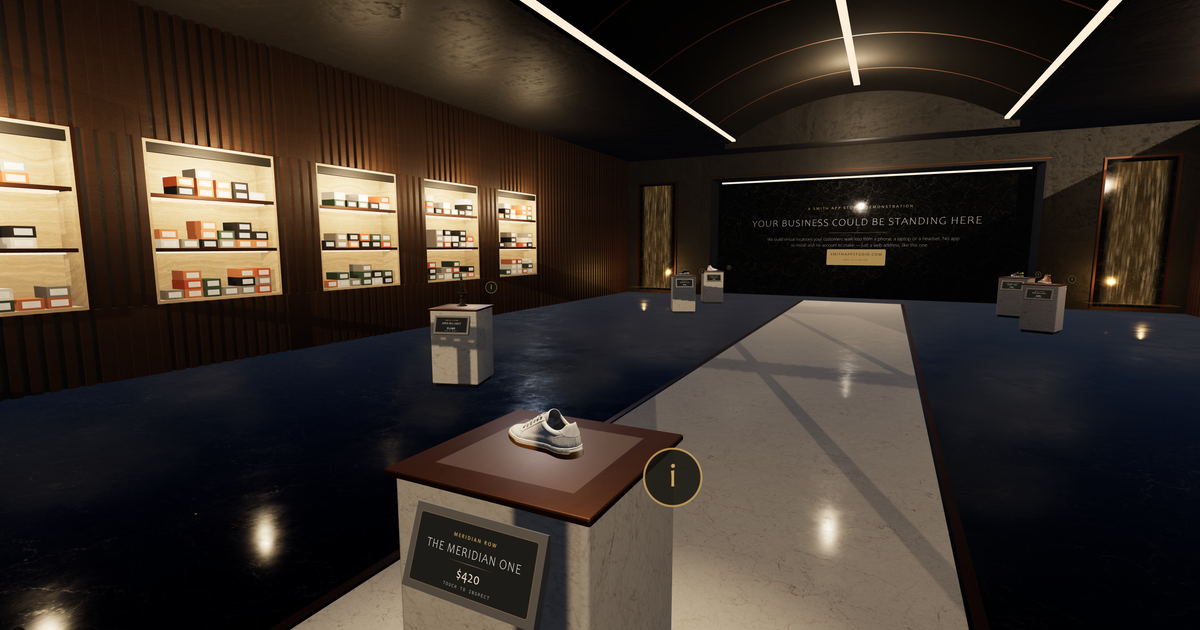
The short version: a product photograph is a decision you make on the customer’s behalf — this angle, this light, this moment. A real three‑dimensional model hands that decision back. The shopper walks around the object, turns it over, and on a headset lifts it off the stand. We just opened a boutique built entirely this way: walk Meridian Row.
The quiet problem with the product photo
Every online shop has the same silent conversation. The customer wants to know what the thing is actually like; the shop answers with eight pictures and asks them to believe it. The angles nobody photographed are the ones they wonder about, and scale is a guess against a white background. Anyone who has ordered furniture that turned out enormous has paid for that gap — and so has the seller, in returns.
Photographs are not the problem. Being limited to someone else’s choice of angle is the problem.
What a “real 3D product” actually means
Not a spinning GIF, and not a video of the object. A real model is geometry — a surface in space — wearing materials that describe how it behaves under light: how rough the rubber is, how the leather creases, where the metal catches. Drop it into a room and it is lit by that room. The reflection on the toe of the shoe in our boutique is the actual ceiling strip above it. Move the shoe and the reflection moves, because nothing about it was painted on.
Scale stops being a guess, too: the object is a real size, and the customer is a real height walking past it.
How your product becomes one
Two honest routes, depending on what you sell.
- Photograph it. Photogrammetry means shooting the object from every angle and letting software reconstruct the surface. It captures the real item — the stitching, the grain, the scuff on the heel. Best for anything soft, worn or textured, where the character is the point.
- Build it from the drawings. If the product is engineered, the exact geometry already exists in CAD. Building from it gives a flawless object with no wear at all — right for hardware, fixtures and machined goods, wrong for a leather bag that should look lived in.
Either way the model is reduced so it opens quickly on a phone, then given materials that respond to light — the mechanics are on the 3D product models page.
Then the part a website has never been able to do
In a headset, you reach out, squeeze, and the product leaves its plinth. It turns as your wrist turns. You bring it to your face to read the stitching, then open your hand and it eases back home. On a phone there is no hand to track, so the product turns under a drag — the customer still chooses the angle, just without the weight.
That gap between looking at a picture and holding the thing is most of what a shop is for, and a product page has never crossed it.
A catalogue, not a diorama
The trap with 3D retail is a beautiful room that is obsolete the week a product changes. So the room reads from the product list: each item carries its own name, price and stand, and adding one is configuration, not a rebuild. In Meridian Row even the film on the back wall renders from that same list — change the catalogue, re‑render, and the wall is current without hiring a crew.
Walk one before you believe any of this
Meridian Row is a lamplit boutique where every shoe is a true object on its own plinth. It opens from a plain link on the phone in your pocket. Pick something up, turn it over, look at the sole — then picture your own catalogue standing there instead. The rest of our rooms are at smithappstudio.com/vr, the business case is in how immersive commerce works, and the wider argument is in your website’s next page is a room.
Meridian Row is a demonstration storefront. The shop and its products are fictional, nothing is charged and nothing ships.
Frequently asked questions
Why is a 3D product model better than a product photograph?
A photograph fixes one angle, one light and one moment that the seller chose. A 3D model hands those choices to the customer: they walk around the object, crouch to it, turn it over and look at the parts a photo never shows — the sole, the underside, the back of the heel. It is the closest thing the web has to picking something up off a shelf.
How does a real product become a 3D model?
Two routes. Photogrammetry means photographing the object from every angle and letting software reconstruct it, which captures the real thing down to the stitching, the grain and the scuffs. The other route is building it from the manufacturing drawings or CAD, which suits engineered products where the drawings already exist and are exact. Soft goods and worn, textured items usually scan; machined and moulded products usually build.
Can customers pick products up in a virtual store?
In a VR headset, yes — you reach out, close your hand on the grip and the product leaves its stand and turns as you turn your wrist. On a phone or a laptop there is no hand to track, so the same product opens and turns under a drag. Both let the customer control the view; only the headset gives them the weight of holding it.
Do shoppers need a headset or an app to visit?
Neither. A storefront built on WebXR opens in the browser already on the device — a joystick on a phone, the keyboard on a computer, and full immersion on a headset when one is present. There is nothing to install and no account to create.
How many products can a virtual storefront hold?
The shop is driven by a product list rather than hand-built scenery, so adding a product is a line of configuration, not a rebuild. The practical ceiling is not the catalogue size but how much a visitor can be asked to walk past before the room stops being a pleasure to be in — which is a merchandising question, the same one a physical shop answers.