
From the Journal · October 13, 2026
What a Walkable Store Actually Does for a Business
Meridian Row is open. Strip away the novelty and five plain commercial jobs are left — and every one of them is something a product page has never managed.
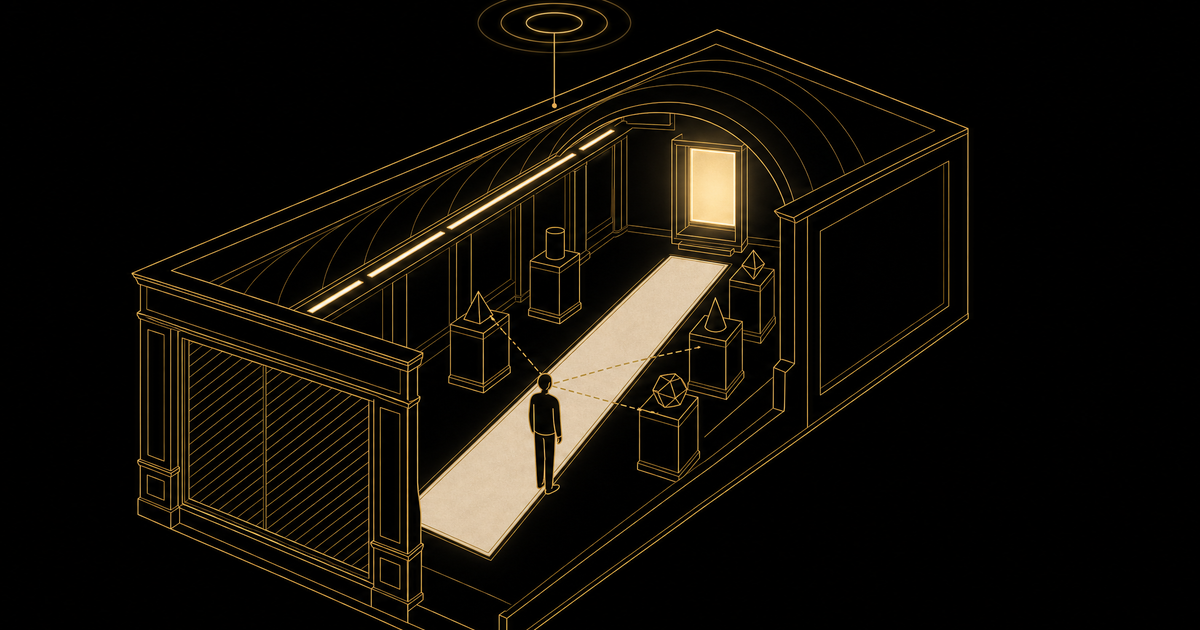
The short version: a walkable storefront is not a novelty item, it is a sales tool. It answers the questions a photograph leaves open, it travels as one link that works on any device, and it cannot go stale, because it reads your catalogue instead of being hand‑built around it. Walk the demonstration first: Meridian Row.
1. It answers the question that loses you the sale
A shopper wants to know what the thing is actually like. Most shops answer with eight photographs and ask them to take it on trust — and the angle nobody shot is always the one they wondered about. Size, against a white background, is a guess.
In a room none of that applies. The object is a real size and your customer is a real height walking past it: they crouch to the sole, turn it over, bring it close enough to read the stitching. Guesswork is what returns are made of, and a return is paid for twice — once in the shipping, and once in a customer who decides you are not worth the risk again.
2. It makes you the only business in your category with a place
Your competitors have pages, and pages get compared in browser tabs, side by side, on price. A place is not compared; it is visited, and remembered. More usefully still, a place gets sent — forwarded to a colleague, or opened on a phone in a meeting to show a buyer what you do. Nobody forwards a product grid for the pleasure of it.
3. One link, every device, nothing to install
The room runs on WebXR, the open browser standard for 3D and headsets, so it opens in the browser already on the device: a thumbstick on a phone, the keyboard on a laptop, and full immersion in a headset. Nothing to download, no account to create.
What that is really worth is distribution. A QR code in a window. A link in an email signature. A tablet on a trade‑show table. A link dropped into a message at eleven at night. Everything you already send people can now lead somewhere they can walk.
4. It reads your catalogue, so it cannot go stale
The trap with 3D retail is a beautiful room that is obsolete the week a product changes. Meridian Row is driven by its product list instead: every item carries its own name, price and stand, so adding one is a line of configuration, not a rebuild. Even the film on the back wall renders from that list: change the catalogue, re‑render, and the wall is current without hiring a crew.
5. You keep the assets, not just the experience
Fixed scope, clear milestones, and you own what we build — the world, the 3D models and the source files. That matters, because a model of your product outlives the storefront: it can stand in an augmented‑reality view on a customer’s own floor, turn in a viewer on an ordinary product page, or appear in a partner’s space. The same model commissioned under somebody else’s terms, and delivered only inside their platform, cannot move when that relationship ends. Nexaria Digital makes that case at length.
Who this is honestly for
It earns its keep where the detail is the value and the purchase is a considered one: footwear and apparel, furniture and lighting, jewellery, instruments, fixtures, machinery too large to take to a trade show — anything you currently sell by getting a person into a showroom. It is the wrong tool for a thousand commodity items at thin margin. A room is not a cheaper grid; it is better at a different job.
Walk it before you believe any of this
Meridian Row is open now: a lamplit boutique where every shoe is a true object on its own plinth, with a narrated tour if you would rather be shown round. Go in, pick something up, look at the sole — then picture your own catalogue standing there. The other rooms are at smithappstudio.com/vr, the mechanics are in how immersive commerce works, the build side in your products, standing in a room, and the wider argument in your website’s next page is a room. To talk about one of your own, write to smithappsupport@gmail.com.
Meridian Row is a demonstration storefront built by Smith App Studio. The shop and its products are fictional, nothing is charged and nothing ships.
Frequently asked questions
What does a virtual showroom actually do for a business?
It does four things a product page cannot: it lets the customer choose every angle instead of accepting the one you photographed, it gives them a true sense of scale because they are a real height standing beside a real-sized object, it gives you a single link worth sending and forwarding, and it stays current because the room is generated from your product list rather than hand-built around it.
Do customers need a VR headset or an app to visit?
Neither. A storefront built on WebXR opens in the browser already on the device — a thumbstick on a phone, the keyboard on a laptop, and full immersion on a headset when one is present. There is nothing to install and no account to create. The headset is an upgrade, not the entry fee.
Will a 3D storefront reduce my returns?
It attacks the most common cause of them. A large share of returns come from the gap between what a photograph implied and what arrived — the wrong size, the wrong finish, a detail nobody could see. Letting a customer walk around the object at its true size and inspect it from any angle closes that gap. We will not promise you a number: your return rate depends on your catalogue, your sizing and your customers, and anyone quoting a percentage before seeing those is guessing.
What kinds of business is a walkable storefront right for?
Considered purchases where the detail carries the value: footwear and apparel, furniture, lighting, jewellery, instruments, fixtures and equipment too large to bring to a trade show — and any business that currently sells by getting people into a showroom. It is a poor fit for large catalogues of low-margin commodity goods, where a conventional grid does the job better.
Who owns the 3D models and the world once it is built?
You do — the world, the models and the source files, under a fixed scope with clear milestones. That matters because a 3D model of your product has a working life well beyond one storefront: augmented reality, product-page viewers, partner spaces and marketplace listings all read the same file. A model you cannot take with you is a model you are renting.
How does the shop stay up to date when products change?
The room reads a product list. Each item carries its own name, price, model and stand, so adding, removing or repricing a product is configuration rather than a rebuild, and the signage and in-store screens re-render from the same source. That is the difference between a storefront and a diorama.